
Building the Marketing Engine for a Modern Industrial Growth Platform
All World Machinery had strong technical expertise, loyal customers, and a broad product ecosystem, but marketing lacked the structure, governance, and strategic clarity needed to support the company’s next stage of growth. I built the planning systems, brand architecture, campaign strategy, digital foundation, and measurement discipline needed to turn marketing into a more accountable business function.
Omnichannel Marketing System Built in One Year
Brand Modernization & Structural Overhaul
Led a full brand transformation for All World Machinery — revamping the website, building a new sub-brand for a major acquisition, and introducing structure to an unorganized marketing foundation. Established consistent messaging, visual identity, and campaign systems that positioned the company as a modern, unified industry leader.
Customer Insight
& Strategy
Developed in-depth customer personas through interviews, feedback, and data analysis. Used these insights to guide A/B testing, refine messaging, and better align campaigns with real customer needs.
Digital Growth & Engagement
Led a persona-driven omnichannel strategy across email, web, paid social, and search—raising email open rates from 15.3% to 23.7%, CTR from 1.2% to 5.1%, and growing subscribers by 25.5%. Reallocated budget to high-performing channels and advanced SEO through optimized metadata, internal links, and TL;DR summaries, driving +40% organic sessions, +74% direct traffic, and +117% paid search growth year over year.
Measurement & Performance System
Before the overhaul, marketing wasn’t consistently tracked, which meant there was no baseline to improve and optimization was mostly guesswork.
To fix that, I established KPI baselines across web traffic, email performance, and conversion behavior, then implemented consistent reporting so results could be tracked, compared, and improved over time.
My Goal
When I joined All World Machinery, the business had significant market opportunity but lacked a modern marketing infrastructure. Campaigns were often reactive, messaging was inconsistent across business units, reporting was fragmented, and the brand did not fully reflect the company’s technical credibility or expanding capabilities.
My role was to build the connective tissue between strategy and execution. I created a more disciplined marketing operating system that connected annual planning, customer insight, campaign development, channel governance, sales enablement, digital optimization, and performance measurement.
The result was a more modern, measurable, and scalable marketing function capable of supporting not only day-to-day demand generation, but also larger business priorities including acquisition integration, brand architecture, product launches, and long-term growth planning.
What Needed to Happen
Build the marketing operating system
Create planning discipline, campaign governance, channel standards, reporting cadence, and repeatable workflows so marketing could scale beyond one-off execution.Modernize the brand and digital experience
Update the company’s messaging, website structure, visual identity, and content strategy to better reflect its technical credibility and customer value.Connect marketing to revenue behavior
Use analytics, search behavior, email engagement, paid media performance, and Lead Forensics data to identify buying intent and improve sales-actionable visibility.Support business expansion through brand architecture
Help integrate acquired and adjacent business units, including Titan Machinery Sales and CNC Solutions, into a clearer market-facing ecosystem without losing their specialized credibility.
Website & SEO
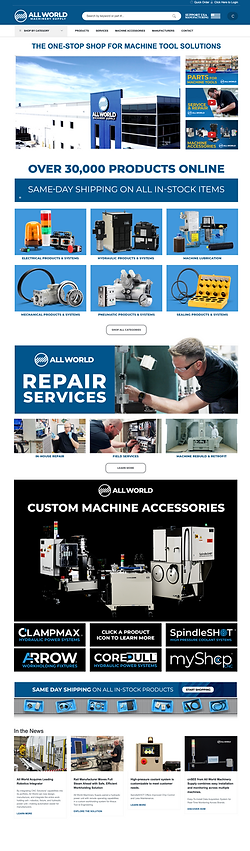
When I arrived at All World, the website was underperforming across every meaningful indicator. It was difficult to navigate, outdated in tone and structure, and under-optimized for search visibility. More importantly, it wasn’t reinforcing the company’s expertise or reliability. The goal was to turn the website into a modern, customer-centered channel that didn’t just inform, but consistently drove action.
I started by partnering with an external SEO firm to run a full technical crawl and performance audit. The findings uncovered duplicate metadata, thin content across key product pages, and structural issues limiting discoverability and performance. From there, I led a comprehensive SEO and content overhaul designed to improve both customer experience and measurable outcomes:
Modernized page content and optimization strategy using high-intent keywords, improved metadata, and concise, persona-informed copy
Improved usability and content structure by adding TL;DR summaries and clear subheadings to increase readability, dwell time, and search snippet capture
Rebuilt navigation and category architecture to reduce friction, shorten clicks-to-conversion, and surface high-demand products faster
Revamped homepage messaging and conversion paths with clearer hierarchy, stronger CTAs, and simplified product categorization to guide customers to the right solutions quickly
Directed brand-aligned visual and design updates including refreshed banners and category visuals to match the modernized identity
Introduced a consistent optimization cadence supported by analytics, continuously testing what drove the strongest engagement and refining user flow accordingly
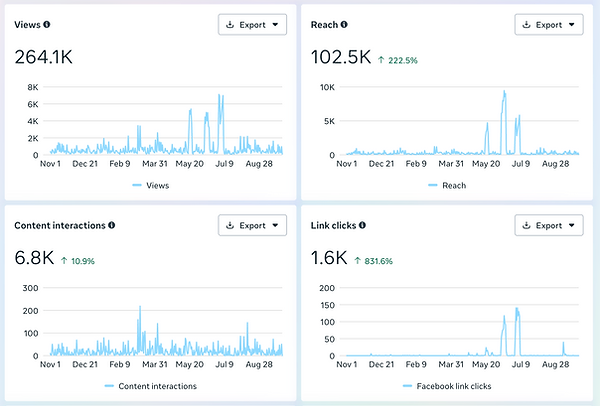
The response was immediate — customers complimented the redesign for being clearer, faster, and easier to navigate. Search performance and traffic metrics reflected the same growth:

Converting Traffic into Sales-Actionable Leads
Increasing traffic was only part of the equation. To turn that visibility into pipeline impact, I implemented a stronger process for converting anonymous web activity into actionable sales intelligence using Lead Forensics.
This allowed us to identify high-intent companies visiting the site, understand what pages and product categories they were engaging with, and prioritize outreach based on real behavior instead of assumptions. I used Lead Forensics insights to:
Surface high-value accounts showing active research behavior even when they didn’t submit a form
Create a clearer handoff between marketing and sales by translating web engagement into usable lead context (company activity, content interest, and timing)
Align follow-up messaging with the buyer’s needs based on the exact product areas they explored
Strengthen measurement and accountability by tying website improvements directly to lead generation outcomes, not just traffic growth
The result was a website that didn’t just perform better in search, but functioned as a more complete acquisition channel, improving both customer experience and the ability for sales to act quickly on real interest signals.
Email Marketing & Customer Insight Strategy
Before I arrived, All World’s email marketing lacked structure and repeatability. Campaigns were often conceived and executed last minute, reactive ideas built a week before sending, with little alignment to customer needs, seasonal demand, or business goals. There was also no real automation or segmentation infrastructure in place, meaning customers received largely one-size-fits-all messaging regardless of what they cared about, what they were researching, or where they were in the buying cycle.
My goal was to turn email into a strategic, insight-driven communication system: one that informed, engaged, and converted consistently through better targeting, stronger governance, and measurable improvement.
I started by building a clearer understanding of how our customers actually buy. I spoke directly with customers, interviewed long-term accounts, and partnered closely with our sales and technical teams to capture real pain points and decision drivers.
In parallel, I developed a deeper layer of industry-based demand intelligence by researching seasonal patterns, buying windows, and common purchase groupings, then translating those into a month-by-month content strategy. This helped identify high-probability demand moments driven by real triggers like heat, cold-start failures, filtration load, humidity, and maintenance shutdown cycles.
That insight gave email a real job to do: show up with the right message at the right time, with the right products tied to real maintenance situations.
A major limitation early on was that email was entirely manual and lacked automation. There weren’t strong customer demographics or behavioral signals built into the process, and there wasn’t a structured way to consistently deliver specialized content based on what customers were actually interested in.
To fix that, I implemented a system that:
-
Reduced last-minute campaign chaos by shifting to a six-month rolling email strategy
-
Introduced automation to create a steadier stream of customer communication instead of irregular, one-off blasts
-
Established email channel standards, including segmentation rules, campaign cadence, and KPI definitions to make performance measurable and repeatable
-
Improved targeting by aligning content to real engagement signals, allowing follow-ups and messaging to reflect the categories and solutions customers were actively exploring
-
Created a repeatable campaign structure so the channel could scale without reinventing the process every send
To increase performance and build a reliable improvement loop, I introduced:
-
A/B testing across subject lines, send times, layouts, and CTAs
-
Persona-based campaign pillars such as Quick Fix Guides, Prevent Downtime Tips, and Spotlight: Hard-to-Find Parts
-
Segmentation by industry, role, and engagement level to increase precision and reduce wasted sends
-
Standardized templates and design systems to speed production and improve brand consistency
-
Continuous iteration using campaign learnings to refine pacing, messaging, and content mix
This approach brought structure, relevance, and long-term strategy to a previously ad-hoc process, turning email into one of All World’s most dependable performance channels and a repeatable driver of engagement and demand.

OLD STYLE


NEW STYLE


Social Media
Rebuilt the company’s social presence from the ground up with consistent scheduling, persona-based content themes, and improved creative quality. Expanded organic reach through storytelling, product education, and cross-channel coordination.

Rebranding Titan Machinery Sales and CNC Solutions
As All World Machinery expanded through acquisition, one of the most important marketing challenges was creating a clearer brand architecture across a growing industrial portfolio. The goal was not to erase the equity of acquired companies, but to modernize their identities, clarify their value, and connect them to the scale, credibility, and support of the All World platform.
Titan Machinery Sales Rebrand
Titan Machinery Sales required a rebrand that balanced legacy trust with a stronger connection to All World Machinery’s broader machine tool ecosystem. As an established machine sales and service business, Titan had valuable category credibility, but its identity and messaging needed to better support its role within the larger company portfolio.
I led the strategic repositioning of Titan as a specialized machine tool sales and service division backed by All World’s broader parts, repair, service, and customer support infrastructure. The rebrand focused on preserving Titan’s technical credibility while creating a more modern and cohesive market presence.
The work included clarifying Titan’s value proposition, defining its role within the All World brand system, modernizing its messaging, and creating a more scalable identity direction for web, sales collateral, customer communications, and future campaign development.
The result was a brand strategy that positioned Titan not as a disconnected acquisition, but as a focused specialist within a larger industrial growth platform.
OLD STYLE

NEW STYLE

CNC Solutions Rebrand
CNC Solutions required a different kind of rebrand. While Titan strengthened All World’s machine tool sales position, CNC Solutions expanded the company into a higher-growth automation and robotics category. The rebrand needed to communicate more than ownership change. It needed to tell a broader story about All World’s evolution from a parts and service provider into a more complete manufacturing solutions partner.
I helped reposition CNC Solutions as the automation and robotics arm of the All World platform, connecting its capabilities in robotic integration, machine tending, welding automation, material handling, and custom automation systems to All World’s existing strengths in parts, repair, service, workholding, and machine support.
The strategy focused on making the acquisition easier for customers to understand: All World could now help manufacturers not only recover from downtime, but also build smarter systems that improve throughput, reduce labor dependency, increase consistency, and support long-term operational efficiency.
The rebrand included updated positioning, buyer messaging, campaign strategy, web content, sales enablement, and ABM landing page planning for high-value automation prospects. By connecting CNC Solutions to All World’s broader industrial ecosystem, the brand became part of a larger growth story around manufacturing performance, automation readiness, and lifecycle support.
Together, the Titan and CNC Solutions rebrands helped create a clearer portfolio strategy for All World Machinery: a connected platform spanning parts, machine sales, repair services, automation, robotics, and manufacturing support.
OLD STYLE

NEW STYLE

Outcome
Within a year, All World Machinery’s marketing function evolved from a fragmented, reactive operation into a structured, insight-led growth system with clearer strategy, stronger execution, and measurable business impact.
Marketing became more than a service department. It became a strategic function operating with defined goals, repeatable systems, a six-month rolling plan, a one-year planning horizon, and a roadmap tied directly to business performance. Campaigns, product launches, content, sales enablement, events, paid media, email, web, and reporting were no longer managed as disconnected activities. They became part of a coordinated operating system built around customer behavior, business-unit priorities, and revenue opportunity.
Externally, the All World brand became clearer, more credible, and better aligned to the company’s expanding role in the industrial market. Updated messaging, stronger visual standards, improved web content, and more consistent campaign execution helped reposition All World from a parts supplier into a broader manufacturing solutions partner spanning parts, repair services, machine sales, workholding, automation, robotics, and lifecycle support.
This brand evolution also extended across acquisitions. Through the rebranding of Titan Machinery Sales and CNC Solutions, I helped create a clearer portfolio architecture that preserved the credibility of each acquired business while connecting them to the scale and support of the All World platform. Titan was positioned as a specialized machine tool sales and service division, while CNC Solutions became the automation and robotics arm of the company’s growth story.
Digital performance also became more strategic. Website improvements were not just SEO updates; they strengthened the customer experience, clarified conversion paths, improved findability, and created stronger demand capture across high-intent categories. By combining SEO/GEO, SEM, landing page optimization, retargeting, and better content structure, All World increased visibility while improving the quality of engagement. Lead Forensics added another layer of value by turning anonymous website activity into sales-actionable account intelligence, helping the team identify high-intent companies and understand what products or services they were researching.
Internally, marketing became more scalable and predictable. I implemented HubSpot and helped establish the company’s first formal CRM and KPI infrastructure, connecting ERP, email, paid media, social, web analytics, and executive reporting into a fuller view of marketing performance. This gave leadership greater visibility into pipeline contribution, bookings, revenue influence, channel ROI, engagement quality, and where marketing investment was creating impact.
The email program also shifted from broad, one-size-fits-all sends to more segmented lifecycle communication. By using audience-specific nurture tracks, buying-cycle logic, engagement behavior, and campaign planning, customers began receiving more relevant content tied to what they were actually interested in. This improved email performance, strengthened repeat engagement, and created a more disciplined communication rhythm across long industrial buying cycles.
I also created new customer touchpoints beyond digital, including All World’s first formal direct mail and package insert program. By using outbound shipments as a marketing channel, the company turned an existing operational moment into a low-cost opportunity to cross-sell, educate customers, promote adjacent services, and stay visible after purchase.
Operationally, the team moved from last-minute execution to a more disciplined production model. The six-month rolling calendar, clearer campaign briefs, improved workflows, agency coordination, and AI-enabled content and GTM intelligence system helped increase output, reduce bottlenecks, shorten production cycles, and improve on-time delivery. What had once been ad hoc became more organized, measurable, and easier to scale.
Most importantly, marketing decisions became rooted in customer behavior and demand timing. By researching industry seasonality, buying windows, common purchase groupings, product relationships, and customer pain points, I built a clearer view of what customers buy, when they buy it, and what triggers demand. Those insights were translated into a month-by-month marketing strategy that helped the business plan proactively while staying flexible enough to respond to urgent market needs.
The foundation built during this transformation positioned All World to operate like a modern industrial growth platform: brand-aligned, data-informed, acquisition-ready, sales-connected, and built for sustained growth in a competitive market.